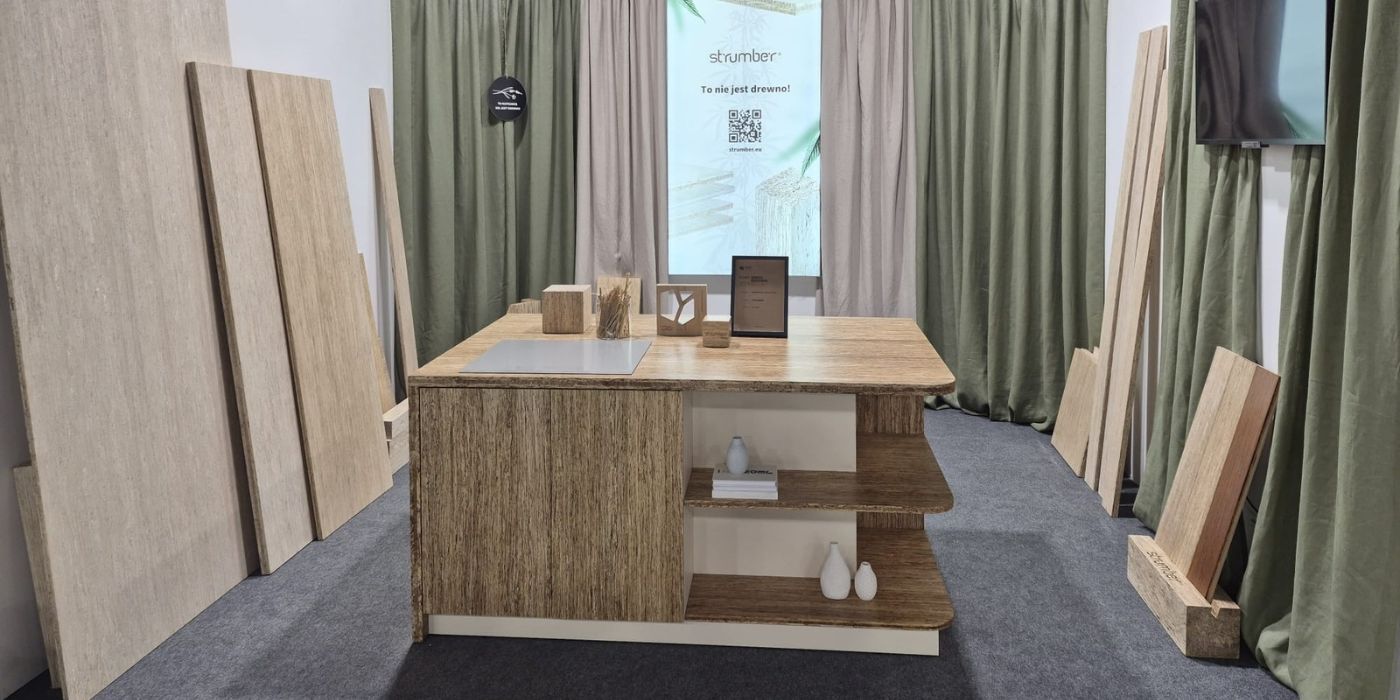
The 10th edition of Warsaw Home Kitchen gave us an opportunity to present Strumber in a slightly different context than before. This time, we exhibited in the hall dedicated to kitchen equipment and design, showing that the potential of materials made from annual plants extends far beyond traditional furniture applications.
At the centre of our stand was a kitchen island made from Strumber Hemp boards. Our aim was not simply to showcase the material itself, but above all to demonstrate how it can work in a finished design – as an everyday interior element that combines aesthetics, durability and a conscious choice of raw material.
The slogan “THIS IS NOT WOOD” effectively caught visitors’ attention. Many conversations began with one simple question: “If it’s not wood, then what is it?” This provided the perfect starting point for introducing the story of Strumber – a material made from the stalks of industrial hemp grown in Polish fields.
The fact that the material is hemp-based often came as a surprise. Even greater interest was sparked by the fact that Strumber is made from Polish raw materials and manufactured in Poland. For many visitors, this was an added value, demonstrating that innovative materials of the future can be developed locally, using domestic resources.
We were particularly pleased with the reactions of joiners and carpenters specialising in bespoke kitchens. They saw Strumber as a new and interesting material that they could add to their product range and offer to clients looking for something distinctive. They did not limit themselves to examining samples – they tested the worktop surface, opened the cabinets, touched the interior panels and looked closely at how the handles were fitted. It was this direct interaction with a finished installation that offered the best opportunity to explore the material’s properties and see how it performs in practice.
The kitchen island presented at the exhibition was made from Strumber Hemp boards in three different thicknesses, each selected to suit the function of a particular component. The worktop was made from a 36 mm board, the corner shelves from 22 mm boards, and the cabinet fronts from 18 mm boards.
This arrangement demonstrated the variety of applications possible within a single kitchen installation. Importantly, the 18 mm board can also be used to make worktops. Its three-layer cross-laminated structure provides high stiffness and stability, opening up further design possibilities.
Visitors paid attention not only to the appearance of Strumber, but also to its mechanical properties, which are comparable to those of solid oak. There was considerable interest in using the material for components that need to withstand everyday use. For joiners and carpenters, it was particularly important that Strumber can be processed using standard tools and machinery commonly used for woodworking.
Of course, as with any material, it is important to understand its specific characteristics and adapt the manufacturing process accordingly. That is why we are happy to share the experience we have gained over several years, providing instructions and practical guidance on cutting, sanding and surface finishing.
Interior designers and architects showed considerable interest in our stand. For this group, the possibilities of shaping the material’s final appearance – particularly its colour and finish – were especially important.
The unfinished Strumber Hemp board attracted the most attention. Its distinctive, irregular texture reminded some visitors of natural travertine. This is an interesting association, as it shows that Strumber does not need to imitate conventional wood. It can become a distinctive design feature in its own right, giving an interior an entirely new character.
We also presented samples finished with wood stains and linseed oil. Linseed oil worked particularly well with the natural texture of hemp, enhancing the material’s character while complementing its plant-based origins. Although Strumber is currently offered as unfinished boards, we wanted to demonstrate the many possibilities for further finishing. The material can be stained, oiled or lacquered using techniques commonly applied in traditional woodworking. This makes it possible to tailor its appearance to the character of a project – from a natural, raw finish to more classic and understated interior designs.
One of the most interesting aspects of our conversations at the exhibition was the way visitors explored Strumber. They touched its surface, examined the fibres visible in its structure and even took a moment to smell the material. Its natural, straw-like scent was an interesting and unexpected part of the experience for many visitors, further highlighting its plant-based origins.
This kind of direct experience is particularly important to us. There is a lot we can say about Strumber, but only by experiencing its texture, surface and finished components can visitors fully understand its potential.
Appearance and ease of processing are not the only factors worth considering when choosing a material. Strumber also stands out for its environmental and performance characteristics, which are important to both furniture manufacturers and investors who make informed material choices.
One of its key advantages is its favourable carbon balance. The plants used to produce Strumber absorb CO₂ as they grow, and some of this carbon remains stored in the finished material. This is reflected in the results of the analysis, which show negative GWP total values for Strumber Hemp beams, reaching as low as –330 kg CO₂ eq. This demonstrates that the material can not only reduce the use of conventional raw materials, but also achieve a favourable greenhouse gas emissions balance.
The material we bring into our everyday living spaces matters, too. Strumber is characterised by very low formaldehyde emissions, at just 0.006 mg/m³ – a level ten times lower than the limit set by the new, more stringent E05 class (REACH). This is an important advantage for materials used in furniture manufacturing and interior applications.
Fire safety is another aspect worth highlighting. Strumber has achieved a C-s1,d0 reaction-to-fire classification, indicating limited contribution to fire development, low smoke production and no flaming droplets or particles. This means that its qualities extend beyond aesthetics and functionality to include performance characteristics that are important when designing spaces for everyday use.
It is this combination of features that makes Strumber an interesting alternative to conventional materials – bringing together versatility in interior applications with a considered approach to the use of plant-based resources.
The exhibition showed us that the bespoke kitchen sector is very open to exploring new material solutions. Joiners and carpenters see Strumber as an opportunity to make their offering stand out, while designers appreciate it as an interesting material with a distinctive aesthetic and a wide range of finishing possibilities. We were also delighted to welcome younger visitors, mainly students of architecture and materials science, who were keen to discover Strumber and ask about its potential applications. Their interest showed that innovative material solutions matter to the next generation of designers and specialists, who are already looking for alternatives to traditional raw materials and considering how to incorporate them into their future projects.
For us, Warsaw Home Kitchen was above all a confirmation that Strumber can successfully find its place in new areas of interior design and furnishing. The kitchen proved to be an excellent setting in which to demonstrate its properties and show that materials made from annual plants have a real place in everyday life.
We would like to thank everyone who visited our stand, talked with us, tested the material and shared their ideas. Every such meeting brings us closer to new implementations and applications for Strumber.